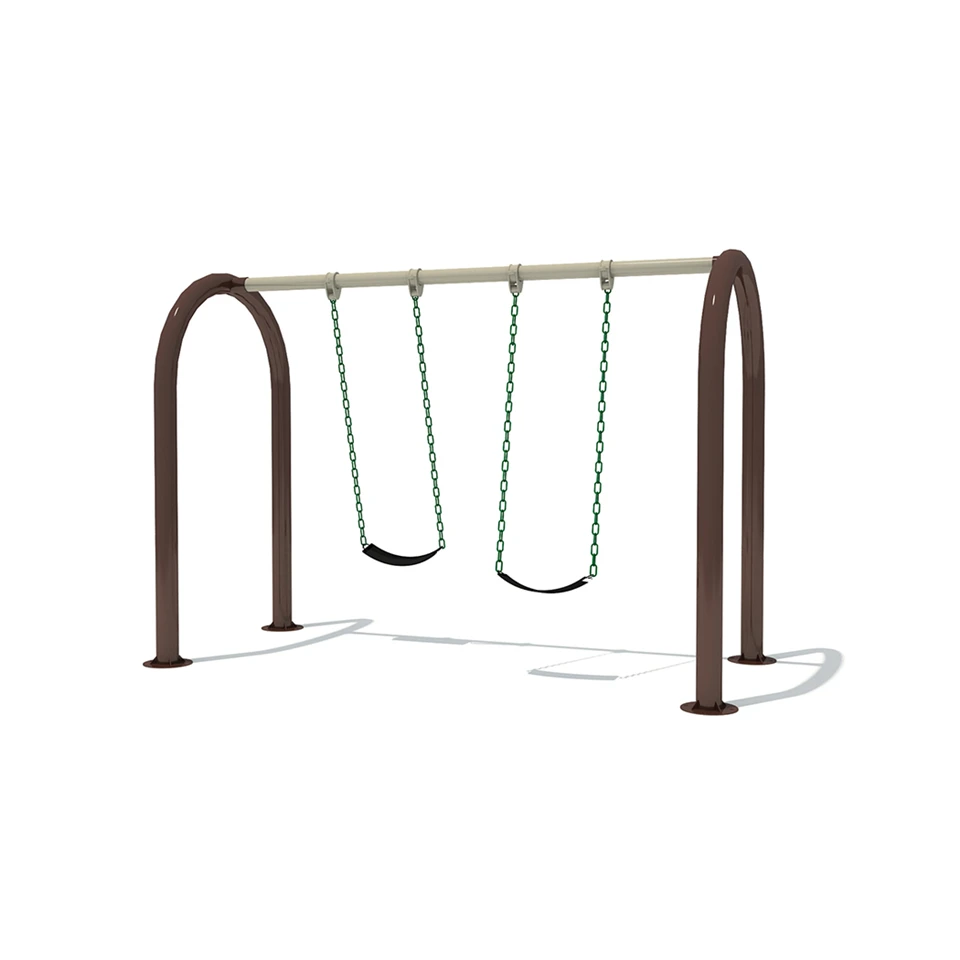
The Arch Swing Frame is used because the curved steel tube compresses the swing load to a large extent according to its length, which is the cheapest method for steel structures, while the straight-legged A-frame must resist the same load when bending at the apex of the connection. The arch also eliminates the knee joint above children's heads, extends the foot wider for stability and keeps welds away from the most stressed areas-three reasons that can be found in popular public playgrounds rather than just in high-end toy catalogues.
The Load Path: Compression Instead of Bending
When a child swings, the frame sees an almost vertical load swing, plus a horizontal component that decelerates at the end of the arc with each swing. In a straight-leg frame, the load peaks in the form of a bend: the horizontal beam spans between the legs, and the legs push back, so the bend holds more torque. Steel uses cross-section depth to resist bending, which is why A-frame needs a wide tube diameter and creases in the corners to disperse the force.
The arch changed geometry rather than material. As the member continuously bends from one foothold to another, the load propagates along the pipe as axial compression and bending moment decrease. The edge tube, which is a bending member, can be comfortable as a compression member. This is the same principle as arch bridges: shape determines the action of the additional material.
Fewer Welds and Longer Fatigue Life
Arch Swing Frame fails due to fatigue before overload fails. A busy swing completes thousands of load cycles in a season, each torsion stress in the same position, and welded joints concentrate the stress. The welded joint is where the crack starts, not in the middle of the straight pipe.
This problem is solved by reducing the number of high-stress welds in arched swinging frames. The main parts are bent, not from mitred pieces, so only the key solders sit there on the base plates, the tube satisfying the foothold. This is a meaningful change in fatigue exposure, which explains why arched structures are common in devices that are expected to survive 10 years of daily use.
Hardness, resonance and the Pendulum Cycle
The oscillation acts like a pendulum, with cycles between two and three seconds, meaning the structure is pushed well under one hertz. Chassis are sturdy enough that their natural frequency is much higher than that excitation, but stiffness is no luxury: a flexible frame absorbs energy, and the movement of the frame manifests itself in a noticeable swing at the top of the leg, which loosens the foot over time.
The arches here are effective because the curved members are rigid on their own plane and do not require deep beams. That's why arched swing racks typically span longer legs, allowing several bays in a lower foot and fewer column interruptions.
Arch Versus A-Frame
| Property | Arched Frame | A Box |
|---|---|---|
| Main load action | Axial compression along curves | Curving apex and leg to beam junction |
| Key joints | Bottom plate only | Apex Plus base plates |
| Top clearance; | Safe, head height knee-free | Apex and beam ends in space |
| Footprints | Wider splay, larger planning areas | Smaller, tighter |
| Typical fit | Public Playground, Long Span, Mass Use | Home gardens, tight venues and budget ranges |
| Installation sensitivity | Footing thrust and alignment are more important | Forgive minor setup errors |
A-Frame is no different. It is a triangulated structure that uses less material and packs flat shipping, which is why it dominates the domestic market. The arch earns its place and the frame will be crawled close, rarely inspected and expected to last.
Geometry the Arch Changes on Site
Two results can be drawn from the shape, both of which are part of the installation plan. First, the foot opens outwards so that the horizontal thrust of each foundation is larger than the narrow frame; the foundation must resist that thrust, not just the vertical load. Second, the arch takes up more planning space, which is important for sites where the use area is already close to a fence or path.
Arches have also changed the way children use buildings. The tube that bends during the ascent is a handhold, not one designed to be a fall risk. Equipment standards make climbing accessible as part of a design review, which is why a publicly used arch has an anti-climbing profile or protection rather than an exposed smooth bend.
Material, corrosion and welding quality
The survival or death of outdoor steel depends on its coating system. Hot galvanized steel meets EN ISO 1461 providing a metallurgically bonded zinc layer that protects the steel even where the coating is scratched, and powder coating over galvanised steel adds color without assuming sole responsibility for corrosion. Two details distinguish a good frame from a less costly one: drains or vent holes so there are no sealed pipes to hold condensation, and internal coating or full sealing at the base plates of the catchment.
Welding is the other half. EN 1090-2 sets out the enforcement requirements for steel structures, including welded quality grades, and frameworks built for declared grades are easier to inspect than those known only as ``welded steel ''. For buyers, the practical question is not what standard the supplier is referring to, but whether weld class and coating thickness are appeared on the drawings.
Truly important Inspection Points
Annual inspection of the vaulted swing racks focuses on a shortlist. Check the movement of the base plates or elongation of the bolt holes, as rocking plate is the first sign of foundation failure. Check for frayed hanger bearings and chains or ropes, as frayed hangers alter the load path into the frame. Check the coating around the bend tube for damage, as one chip is the beginning of corrosion. Check the ground under the swing for movement as a moving frame shows movement on the steel surface.
ISO 4980 provides a framework for inspection and maintenance planning for all rides, which is useful when multiple structures share a maintenance schedule.
FAQ
Is the arched frame stronger than the A-frame? For the same tube section, it is usually on a swinging plane because the load is passed in a compressed rather than bent manner. Strength also depends on wall thickness, weld class and foundation design, so this comparison applies only to the same materials.
Why does arch frames need a bigger base? The splayed legs converts vertical load into an external thrust at the bottom. As well as bearing weight, the foundation must also withstand horizontal thrust, and on soft soil the volume of the foundation will increase accordingly.
Can an arch frame be used for a swing? Yes, it's common. With no span to save, the advantage on a single bay is small, but clear top and fatigue behaviour still apply.
And most importantly
The Arch Swing Frame is chosen because the curve converts bending into compression, reduces the number of fatigue critical weld seams, clears space above children's heads and supports stable long spans with fewer columns. It needs more steel and a better foundation-wherever it is, swings will be used every day for years, and that's a fair trade.
Source of information
European Committee for Standardization-EN 1176-1:2017+A1:2023, Playground equipment and paving: general safety requirements and test methods.
European Committee for Standardization-EN 1176-2:2017, Playground equipment and surfaces: additional specific safety requirements and swing test methods.
ASTM International-ASTM F1487-25, Standard Consumer Safety Performance Specification for Playground Equipment.
European Committee for Standardization-EN ISO 1461, Hot galvanized coating on finished fabricated iron and steel articles.
European Committee for Standardization-EN 1090-2, Implementation of steel and aluminium structures: Technical requirements for steel structures.
ISO-ISO 4980:2023, Playgrounds and recreation equipment: inspection and maintenance framework.