Frame design determines stability in three different ways: how the structure resists foot capsizing; how the structure functions when the swing load changes direction twice per cycle; and how the structure handles torsion forces when a swing moves away from the center. The Arch Swing Frame contributes to all three through its open legs, continuously curved member and wide base-but if the base is too small or the ground moves beneath it, the frame alone won't provide stability.
Three Failures that look different on Site
Stability problems rarely manifest themselves in structural breakdown. They come in the form of symptoms, each pointing to a different part of the design.
Walking or rocking. When a child shakes it hard, the frame swings a few millimeters on the base plate. The reason is almost always to do with the foundation or anchor rather than the strength of the pipe.
Sway build-up. The top of the frame is clearly in sync with the swing, and the movement goes on for months. It's a question of stiffness and mass.
Torsion. A swing at the end of a multi-bay frame distorts the entire operation, so the beam rotates and the far bay rises slightly. It's a matter of plane geometry.
It is important to judge which is the case, because the method of repair is different: stiffened frames do not cure loose foundations, and stiffened concrete does not cure a torsion problem.
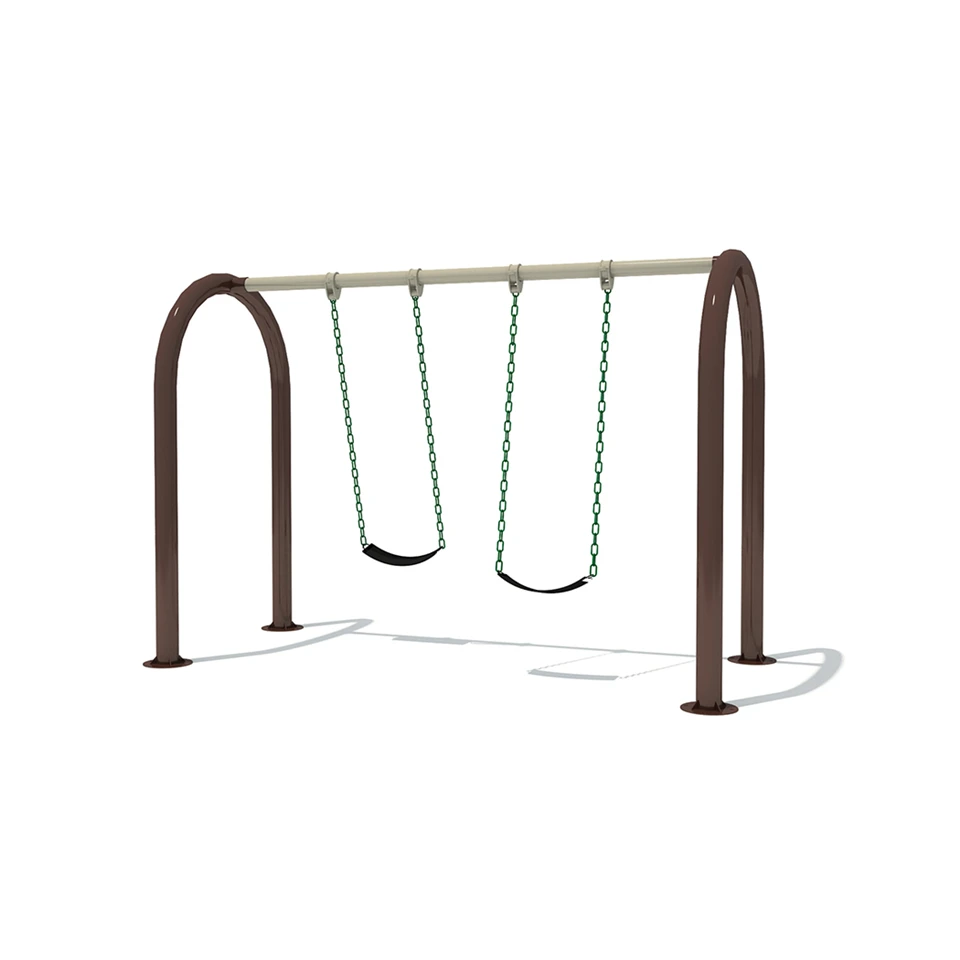
Rolling over: What do feet need to carry?
The swing is a lever. Horizontal force at seat height times the height above ground creates an overturning torque at the bottom, which must be resisted by the base's weight and the passive resistance of the surrounding soil. Windward Uplift is a detail that attracts installers: Vertical-load-only pedestals can still rotate.
There are two design consequences for any arched pendulum. The splayed legs convert some vertical loads into horizontal thrust, so the support can withstand both torque and thrust. Because the arch carries load along a curve, rather than concentrating it at one angle, the base plate is the single most stressed connector in the structure - which is why the thickness of the plate, bolt grade and the spacing of the bolts are more noticeable than is often required by tube diameter buyers.
Geotechnical works were designed in accordance with EN 1997-1, and concrete for the foundations in accordance with EN 206. In fact, a useful question for buyers is who owns the foundation design: if the answer is "the installer's decision," then the stability of the finished swing will be determined by who dug the hole.
Hardness, mass and frequency traps
Stability under a moving load is a frequency problem. The oscillation period is about 2-3 seconds, so the excitation is less than one hertz. The frame has its own natural frequency and is designed to keep that frequency comfortably above the excitation so that the structure does not magnify motion.
The hardness increases the natural frequency and the quality decreases the natural frequency. That's why adding concrete to the base plate isn't a panacea --it dampens movement of the foundation but adds mass to a system that may already be marginal in frequency. Span is much more important than most buyers realize: deflection of the beam increases with the length of the cube, so the distance between legs doubles, making the frame eight times more flexible, unless the cross section increases with the cube.
Arch Swing Frame usually perform well here because curves harden members on the swing plane without the need to a deep fabricated beam. Its weak direction is not on plane, and that weakness is what the next section is about.
Twist: Jet yaw problem
Arches are effective on their own plane and are softer when twisted. At the end of a three-bay run loaded with a wobble, the frame is required to resist the torque it never forms. The visible result is a rotating beam, a far pod to lift, and a hanger to loosen.
Designers tackled the problem in four ways: by placing the loaded swing near the center of the bay, adding a second curved member to form a pair of arches, bracing the base between bays with cables or pipes, or strengthening the base enough to transfer the rotation to the ground rather than the frame. The choice is obvious in the product: a single tube arch spanning four unsupported swings is done by its feet and the support frame will be in steel.
For buyers, the practical test is symmetry. Ask what happens when only one swing in an assembly is used and whether the framework has been analyzed. Vendors with answers will consider torsion, but those describing only static loads will not.
Ground Conditions and the Installation Layer
No frame is more stable than the ground it stands on. Loose fillings, floors and slopes all change the calculation of tipping, and water is the silent destroyer: the foundation in the puddle loses its carrying capacity, accelerating the erosion of the base plate.
Three installation details are most at risk. The bottom plate must be on a flat, dense, fully exposed surface-sliding a plate so it looks horizontal, creating a point load. Bolts must be twisted to the specified value and checked again after the first week of use, as burying can relieve tension. The ground beneath the swing must flow from the base, not toward it.
Playground standards treat installation as part of a safety case, not an afterthought, and ISO 4980 provides a framework for inspection that includes foundations and fixtures, not just physical structures.
What to write in the specs
For vaulted swing racks, specification should determine installation items otherwise improvisation:
foot design responsibility, with the geotechnical basis named.
Concrete grade shall be EN 206 and the cure period before use shall be specified.
Bottom thickness, bolt grade, bolt pattern, torque value.
A payload box covered with a single payload arrangement in a multihull frame.
Drainage detail at each foothold and a drop away from the substrate.
Inspection interval, check lists for base plate movement and bolt torque.
Frequently Asked Questions
Can heavier frames make swings more stable? Unreliable. Mass reduces the natural frequency of the rhythm of the swing itself, and extra weight at the bottom does little to reverse it. Stiffness and foundation design are more important than kilos.
Why move the frame with only one swing? That's the twist. A single load at the end of a run distorts the frame, while the far end lifts it. Props, pairs of members, or stiffer foundations are repaired.
Can stability be improved after installation? Sometimes. Torsion bolts, increased support between bays, or replacement of the failed foot can help, but the geometry of the frame cannot change the scene. It's cheaper to be precise.
And most importantly
Stability of the Arch Swing Frame comes from three different design decisions: an inverted and thrust resistant base, a sturdy frame that keeps the oscillation frequency independent of the swing's two-to-three-second rhythm, and a plan geometry that can withstand a single load swing at the end of the run. Buyers who ask about all three will get a motionless swing; those who ask only about the thickness of the pipe will get a rocking frame.
Source of information
European Committee for Standardization-EN 1176-1:2017+A1:2023, Playground equipment and paving: general safety requirements and test methods.
European Committee for Standardization-EN 1176-2:2017, Playground equipment and surfaces: additional specific safety requirements and swing test methods.
ASTM International-ASTM F1487-25, Standard Consumer Safety Performance Specification for Playground Equipment.
European Committee for Standardization-EN 1997-1, Eurocode 7: geotechnical design, general rules.
European Committee for Standardization-EN 206, Concrete: specification, performance, production and conformity.
ISO-ISO 4980:2023, Playgrounds and recreation equipment: inspection and maintenance framework.